The ongoing outbreak of Bundibugyo virus disease (BVD) in the Democratic Republic of the Congo (DRC), with cases reported in other countries, is a stark reminder that BVD remains an active global health security threat. On 17 May 2026, the WHO declared this outbreak a public health emergency of international concern, citing confirmed cross-border transmission, incomplete epidemiological links, and probable underdetection.1 The outbreak probably began weeks before its declaration on 15 May 2026, allowing transmission to remain undetected.2 As of 15 October 2026, the DRC had reported 9277 laboratory-confirmed cases, including 4478 deaths, with a crude case-fatality ratio of approximately 48%. Uganda had reported 20 laboratory-confirmed cases, including two deaths, while France reported one imported case with no deaths. Kenya also reported an imported case in October.3 However, the outbreak may be larger than reported owing to undetected case clusters, unreported community deaths, and incomplete epidemiological links.4
Ebola disease is caused by filamentous, nonsegmented, negative-sense single-stranded RNA viruses5 that belong to the Orthoebolavirus genus of the Filoviridae family. Six species of Orthoebolavirus have been identified,6 but only three—Ebola virus, Sudan virus, and Bundibugyo virus (BDBV)—have caused large outbreaks in humans. Ebola disease is zoonotic, with occasional spillover from wildlife into humans.7 Initial human infections can occur through direct contact with infected wildlife. Subsequent person-to-person transmission occurs through direct contact with infected blood or other body fluids, or contaminated objects and surfaces, often in healthcare settings.6
The first recognized Ebola disease outbreaks occurred in 1976 in what are now South Sudan and the DRC.6 The BDBV was first identified in Bundibugyo District in western Uganda in 2007 [Figure 1].8,9 In 2012, the second BDBV outbreak was reported in the DRC. The current outbreak, the third recognized BDBV outbreak, is the largest and deadliest on record. This is also the 17th Ebola disease outbreak reported in the DRC.2,10 The current outbreak’s epicenter is in Ituri Province, an active conflict zone where weak health systems, mining-related population mobility, displacement, and limited healthcare access likely delayed detection and amplified transmission.10,11 As in past outbreaks, frequent cross-border population movement, weak surveillance, diagnostic delays, and gaps in infection prevention and control (IPC) have increased international spread. Although three licensed Ebola virus vaccines target Ebola virus (formerly known as Zaire ebolavirus),4 no vaccine or specific therapeutic, including monoclonal antibodies, has been approved for BVD.8
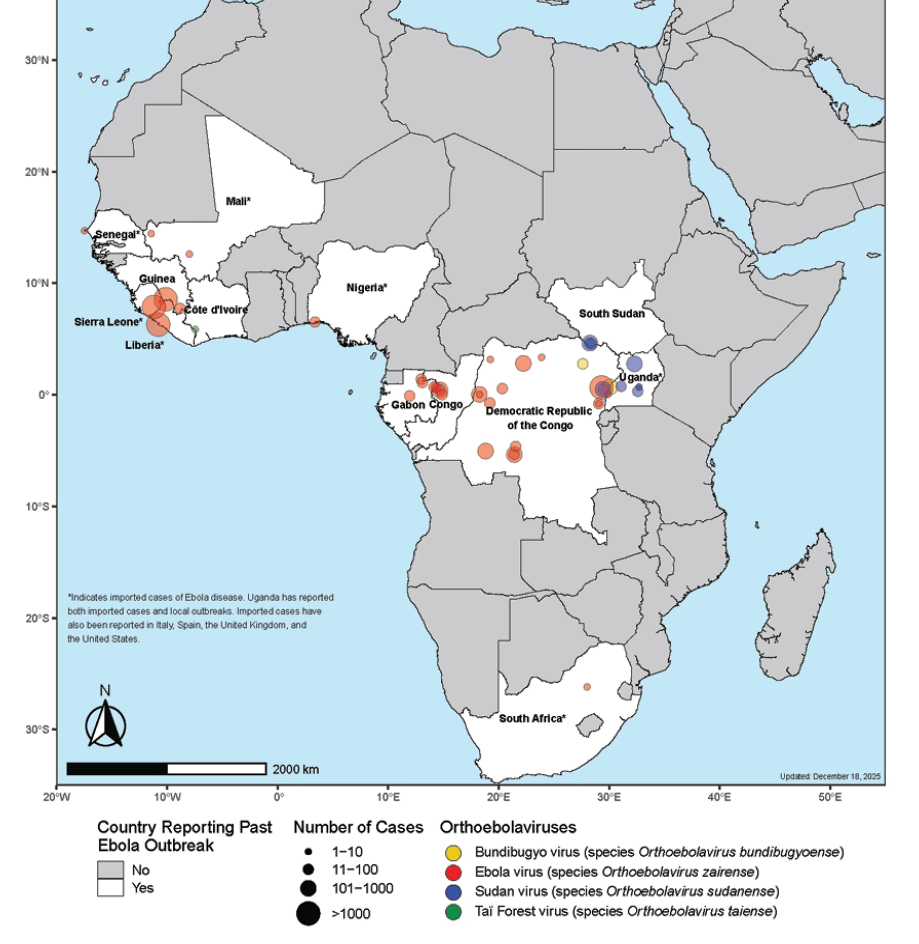 Figure 1: Ebola outbreaks by species and size in western and central Africa since 1976 (map dated 18 December 2025).9 Reproduced from the Centers for Disease Control and Prevention (CDC), History of Ebola Outbreaks. CDC does not endorse this editorial or its content.
The epidemiology of BVD is less well studied than that of Ebola virus disease. However, available information suggests that the epidemiological and virological characteristics, genomic makeup, clinical presentation, and case-fatality ratio of BVD may differ substantially from those of other ebolavirus species known to cause large-scale outbreaks.11 The absence of licensed vaccines and approved specific treatments challenges outbreak control [Table 1].
Table 1: Features relevant to preparedness for Bundibugyo virus disease (BVD) in GCC countries.
|
Fatality ratios
|
Historical Ebola disease case-fatality ratios ≈ 25–90%.6
Pooled historical BDBV case-fatality ratio ≈ 33% (data through 2022; not the current outbreak).12
|
|
Human-to-human transmission
|
Sustained transmission may occur without effective intervention.
Historical (R0) in past outbreaks for other ebolaviruses ≈ 1.3–2.7.13,14 (not BDBV-specific).
|
|
Laboratory diagnostics
|
Detection of viral RNA by RT-PCR (trained staff, appropriate equipment, and validated biosafety).15,16
BDBV-specific assays (Ebola virus specific assays may miss BDBV).16,17
|
|
Laboratory containment
|
BSL-4 required for virus isolation or propagation; primary diagnostic testing requires risk-based containment.16
|
|
Diagnostic access
|
First BDBV molecular test added to WHO’s Emergency Use Listing: 2 July 2026.18
Safe specimen collection, handling, and transport are essential.18
|
|
Clinical diagnosis
|
BVD symptoms are nonspecific: fever, headache, myalgia, and gastrointestinal symptoms that overlap with those of malaria, typhoid fever and other viral hemorrhagic fevers (RVF, CCHF, and AHF) reported in the GCC region. Hemorrhagic manifestations may be absent or develop later.6,15
Long incubation period; travel and exposure history are important; secondary cases may have no travel history.6
|
|
Vaccines and treatment
|
No licensed BVD vaccine or approved specific treatment.8,12
Early supportive care; critical care according to disease severity and organ dysfunction, irrespective of bleeding.5
|
GCC: Gulf Cooperation Council; BDBV: Bundibugyo virus; R0: basic reproduction number; RNA: ribonucleic acid; RT-PCR: reverse transcription polymerase chain reaction; BSL: biosafety level; RVF: Rift Valley fever; CCHF: Crimean-Congo hemorrhagic fever; AHF: Alkhurma hemorrhagic fever; IPC: infection prevention and control.
The Gulf Cooperation Council (GCC) countries (Bahrain, Kuwait, Oman, Qatar, Saudi Arabia, and the UAE), despite their geographic distance from Central Africa, face a tangible risk of importation. The GCC’s strategic role as a global hub for commerce, business travel, and religious pilgrimage, especially the annual Hajj and year-round Umrah, draws millions of visitors each year, creating multiple pathways for viral introduction. A large expatriate workforce originating from diverse regions of Africa, including areas near the epicenter of the current outbreak, further enhances the risk of importation by returning travelers; extensive air connectivity between the GCC countries and Africa amplifies this vulnerability.18 Air travel and religious gatherings have previously facilitated transmission of filoviruses from Africa to other countries within days.2 Thus, the present risk should not be taken lightly.
The WHO’s regional risk assessment currently suggests a low probability of importation into the Eastern Mediterranean Region, but this general estimate may not fully reflect the GCC’s intensive and sustained travel and labor-migration patterns. This higher risk warrants sustained vigilance, real-time multi-country surveillance, and enhanced preparedness rather than complacency.
Because BVD’s early symptoms mimic other febrile and viral hemorrhagic illnesses, and laboratory confirmation requires access to appropriate testing, a high index of suspicion is needed. A patient without hemorrhagic manifestations or a travel history may have had contact with a returning traveler [Table 1]. Healthcare facilities can become sites of transmission amplification during the early phases of outbreaks if diagnosis is delayed and initial cases are missed.5 During the current BVD outbreak in the DRC, the outbreak was officially declared only after a healthcare worker (HCW) died following a severe, unexpected illness.5
Healthcare facilities across GCC countries must therefore use a sensitive case definition and a screening algorithm that considers symptoms, travel, and exposure history at every point of care, including outpatient clinics. Rapid isolation of suspected cases, minimizing unnecessary contact, and immediate access to appropriate personal protective equipment for all HCWs are essential. Training of frontline HCWs must be recurrent rather than one-off, particularly where staff turnover is frequent, and must cover correct donning and doffing, hand hygiene, environmental decontamination, and safe waste management. Protocols for the safe and dignified handling of deceased patients should be established and rehearsed, since unsafe burial and body-handling practices have been recurrent drivers of transmission.6
Past Ebola disease outbreaks and the current BVD outbreak reinforce the principle that early identification of suspected cases and rapid laboratory confirmation provide a window for interrupting transmission. Prompt isolation, clinical care, and contact tracing are essential. Contacts, including exposed HCWs, should be monitored for 21 days after their last exposure.6
Successful control of filovirus disease requires integrating proven medical countermeasures, including clinical care, surveillance, diagnostics, and coordinated multinational public health efforts.5 A regionally coordinated response should therefore rest on four interlocking pillars: cross-border surveillance, decentralized laboratory capacity, IPC, and risk communication with community engagement. Real-time outbreak intelligence, combining clinical and epidemiological data with genomic surveillance and assessment of signals from social media, may help identify unusual transmission patterns early, particularly in countries with mass gatherings.
Active case-finding and digitally supported contact tracing should be tested and made ready for rapid activation if cases occur; these activities could increasingly be assisted by artificial intelligence-based tools to predict hotspots. A decentralized regional laboratory network supported where appropriate by mobile diagnostic capacity, safe specimen collection and transport, shared assays, genomic sequencing, and joint quality-assurance programs, could shorten the time to diagnosis. Healthcare facilities must maintain triage and safe referral systems, workforce training, and supportive supervision. Risk communication strategies should be tailored to the GCC’s exceptionally diverse population of expatriate residents and pilgrims, using trusted channels, including social media and community and religious leaders, to build trust and counter misinformation.
GCC countries should test, not merely draft, their BVD preparedness plans through regular multisectoral simulation exercises involving health, immigration, border-control, transport, and communication authorities. Point-of-entry screening and traveler education cannot be relied on alone, given the incubation period of 2–21 days, during which infected travelers may be asymptomatic and afebrile.6 People infected with ebolaviruses are not considered infectious before symptom onset. Temperature checks at points of entry therefore cannot exclude infection. WHO advises against general travel or trade restrictions in response to this outbreak.19 Cross-country collaboration among GCC countries, including harmonized surveillance and contact-tracing protocols, secure sharing of case and contact information, timely reporting by countries and joint deployment of trained experts, is indispensable. The Gulf Center for Disease Prevention and Control is well placed to coordinate this regional effort. GCC countries should also prepare to access candidate BDBV vaccines, therapeutics, and diagnostic tools and, where feasible, participate in ethically approved clinical trials of candidate vaccines and therapeutics and clinical evaluations of diagnostic tools.20
The GCC countries sit at the crossroads of global travel and business and are inherently exposed to the risk of importing emerging pathogens such as BDBV. Sustained investment in core public health functions can improve outbreak detection and response capacity for filovirus infections and other emerging pathogens. National governments must collectively strengthen surveillance, laboratory diagnostics, IPC, clinical care, and risk communication in an integrated manner and test these systems regularly. The region has experience in successfully managing and controlling other high-threat pathogens. This knowledge should now be applied. The risk of BVD importation should be treated as a call to action: an opportunity for GCC countries to consolidate preparedness now, so they are ready to respond swiftly to BVD and future epidemic threats.
references
- 1. Susanto H, Huda MH, Duong MC, Susilawati TN. Ebola at a critical juncture: preparedness must outpace transmission. Bull World Health Organ 2026 Jul;104(7):442-442A.
- 2. Belizaire MR, Chamla D, Janabi M. Bundibugyo virus disease outbreak in DR Congo: current trajectory and potential risk for a pandemic emergency. Lancet Infect Dis 2026 Jul;26(7):e277-e278.
- 3. World Health Organization. Daily epidemiological update on acute public health events: Ebola disease (Bundibugyo virus) [Internet]. Geneva: World Health Organization. 2026 [cited 2026 Oct 18]. Available from: https://www.who.int/emergencies/alert-and-response.
- 4. Velavan TP, Kremsner PG, Ntoumi F. Bundibugyo Ebola: why preparedness still fails at the point of detection. Lancet Infect Dis 2026 Jul;26(7):e273-e274.
- 5. Sullivan NJ. Bundibugyo virus disease in 2026—clinical and public health responses. N Engl J Med 2026 Jul;395(3):278-289.
- 6. World Health Organization. Ebola disease: key facts [Internet]. Geneva: World Health Organization.; 2025 [cited 2026 Jul 11]. Available from: https://www.who.int/news-room/fact-sheets/detail/ebola-disease.
- 7. Zumla A, Ntoumi F, Ndembi N, Mulangu S, Piot P, Muyembe-Tamfum JJ, et al. Ebola at 50 — lessons for outbreak response and preparedness. N Engl J Med 026 Aug;395(6):527-529.
- 8. Diseases TL; The Lancet Infectious Diseases. Key facts about the Bundibugyo virus outbreak. Lancet Infect Dis 2026 Jul;26(7):651.
- 9. Centers for Disease Control and Prevention (CDC). Ebola outbreaks in western and central Africa since 1976. 2025 [cited 2026 Oct 18]. Available from: https://www.cdc.gov/ebola/outbreaks/index.html.
- 10. Tonen-Wolyec S, Bélec L. The 17th Ebola outbreak in the Democratic Republic of the Congo: a syndemic challenge. Lancet 2026 Jun;407(10546):2369-2370.
- 11. Boum Y, Dereje N, Mercy K, Fallah M, Aragaw M, Tsague L, et al. Ebola disease outbreak caused by Bundibugyo virus in Africa: a defining moment for Africa’s health security and sovereignty. J Public Health Afr 2026 Jun;17(1):2069.
- 12. Izudi J, Bajunirwe F. Case fatality rate for Ebola disease, 1976-2022: a meta-analysis of global data. J Infect Public Health 2024 Jan;17(1):25-34.
- 13. Legrand J, Grais RF, Boelle PY, Valleron AJ, Flahault A. Understanding the dynamics of Ebola epidemics. Epidemiol Infect 2007 May;135(4):610-621.
- 14. Chowell G, Hengartner NW, Castillo-Chavez C, Fenimore PW, Hyman JM. The basic reproductive number of Ebola and the effects of public health measures: the cases of Congo and Uganda. J Theor Biol 2004 Jul;229(1):119-126.
- 15. Brown CS, Mepham S, Shorten RJ. Ebola Virus disease: An update on epidemiology, symptoms, laboratory findings, diagnostic issues, and infection prevention and control issues for laboratory professionals. Clin Lab Med 2017 Jun;37(2):269-284.
- 16. European Centre for Disease Prevention and Control. Laboratory guidance and resources [Internet]. Stockholm: ECDC; [cited 2026 Oct 18]. Available from: https://www.ecdc.europa.eu/en/ebola-disease/surveillance-and-updates/ebola-outbreak/laboratory-guidance.
- 17. World Health Organization. WHO adds first diagnostic test for Ebola Bundibugyo virus to its emergency use listing [Internet]. Geneva: World Health Organization; 2026. [Cited 2026 Oct 18]. Available from: https://www.who.int/news/item/02-07-2026-who-adds-first-diagnostic-test-for-ebola-bundibugyo-virus-to-its-emergency-use-listing.
- 18. Tully DC. Travel restrictions and Ebola outbreaks: public health implications. Lancet 2026 Jun;407(10546):2370-2371.
- 19. World Health Organization. Ebola disease caused by Bundibugyo virus—Democratic Republic of the Congo. Disease outbreak news [Internet]. Geneva: World Health Organization; 2026. [Cited 2026 Oct 18]. Available from: https://www.who.int/emergencies/disease-outbreak-news/item/2026-DON619.
- 20. Nachega JB, Tshiani Mbaya O, Mulangu S, Folayan MO, Ndembi N, Ntoumi F, et al. Clinical trial priorities, adaptive strategies, and equitable partnerships for the Bundibugyo Ebola outbreak. Lancet Infect Dis 2026 Aug;26(8):755-757.